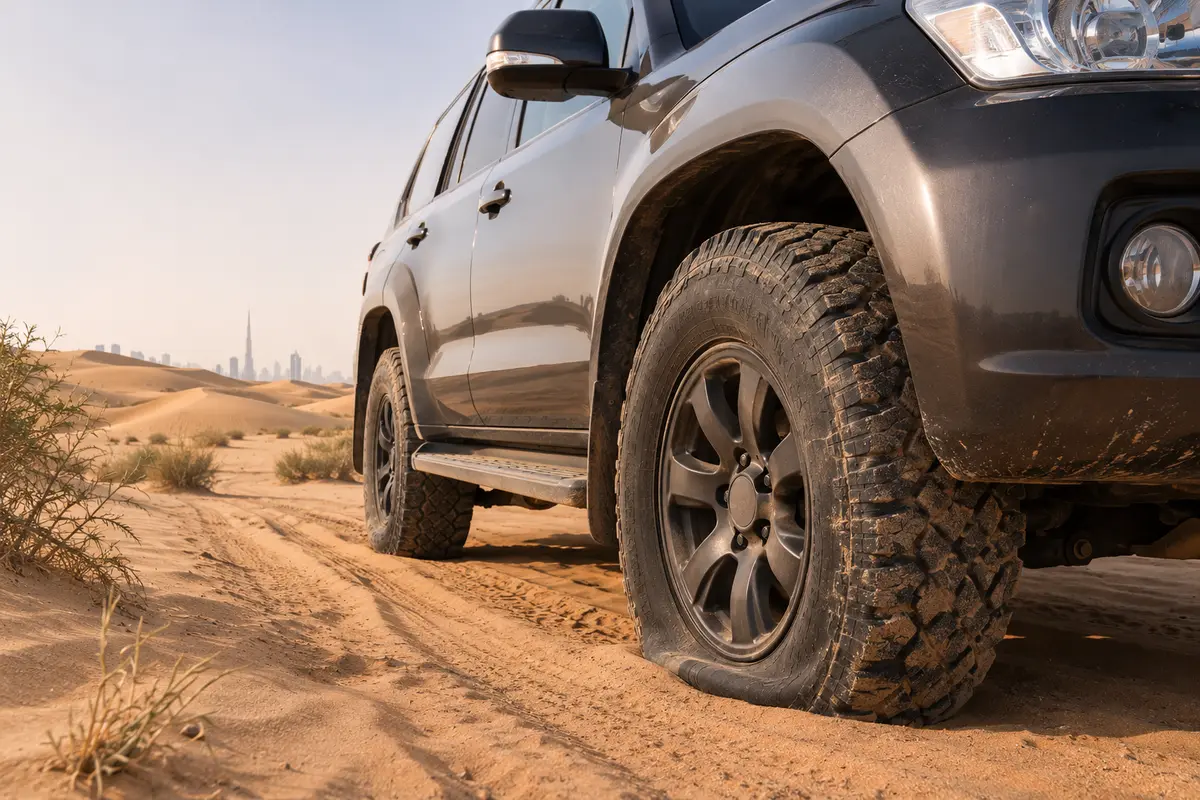
For an SUV that does the school run in Arabian Ranches and the weekly drive to Abu Dhabi on E11, an HT tyre is often the smartest choice. It is quieter, cheaper per kilometre and more fuel-efficient than an all-terrain tyre.
How highway-terrain tyres are built
HT tyres have a closed, rib-type tread with continuous circumferential grooves and fine sipes. The rubber is formulated for wear resistance rather than chip resistance, and the sidewall is two-ply on most standard-load sizes. Shoulder blocks are rounded off for quiet running, with little of the side-biting lug you see on AT tyres. High load indexes, often 110 or more, suit full-size SUVs.
Pros
- Quiet and smooth at 120 to 140 km/h
- Longest tread life of any 4x4 tyre type
- Better fuel economy than AT or MT tyres
- Shorter wet braking distance than off-road tyres
- Usually the cheapest option per kilometre for heavy SUVs
Cons
- Thin sidewalls are vulnerable on gravel and rocks
- Limited grip in deep, soft sand
- Fine tread clogs with mud
- Looks less rugged than AT tyres, if that matters to you
Who should choose highway-terrain tyres
Best for
- SUVs that stay on tarmac most of the time
- Long-distance highway driving between emirates
- Pickups and SUVs used for towing on road
- Occasional, gentle sand tracks with correct pressures
Not ideal for
- Regular dune bashing
- Rocky wadis and mountain tracks
- Owners who want an off-road look
Highway-Terrain Tyres in UAE conditions
A full-size SUV on HT tyres carries more than two and a half tonnes at highway speed through 50°C summer afternoons. That makes load index and pressure critical. Under-inflation combined with heavy load and heat is the classic recipe for a blowout on E611 in July. Keep pressures at the placard value for the load you carry, and check them monthly with a gauge, not by eye.
HT vs AT for a UAE family 4x4
This is the most common question we get from Patrol and Land Cruiser owners. The table summarises the trade-off. Our full write-up is all-terrain vs highway tyres for desert driving.
| Highway-terrain | All-terrain | |
|---|---|---|
| Highway noise at 120 km/h | Low | Moderate |
| Tread life | Longest | Long |
| Soft sand ability | Fair, aired down | Good |
| Sidewall toughness | Standard | Reinforced, often LT |
| Starting price | From AED 380 | From AED 450 |
Can you take HT tyres into the desert?
Yes, gently. Plenty of people drive Al Qudra sand tracks or the edges of the Liwa dunes on HT tyres. Air down to 15 to 20 psi, avoid sharp crests and keep momentum. The weak point is the sidewall, which is thinner than an AT's and can be cut by stones under the sand. Reinflate fully before returning to the highway, and follow our desert pressure guide.
If you are towing a boat or caravan, or the car is full of people and luggage for a long trip, increase pressures to the loaded value on the placard. Check the tyre pressure guide for typical UAE figures.
Getting the full life from HT tyres
- Rotate every 10,000 km. Heavy SUVs wear shoulders unevenly if left on one axle.
- Check alignment after any heavy kerb strike or after driving rough tracks.
- Replace at six years from the DOT date even if tread remains, because UAE heat ages rubber.
- Inspect the spare. Many full-size SUVs carry a matching fifth wheel that has never been checked.
Popular highway-terrain tyres in Dubai
| Brand | Range |
|---|---|
| Bridgestone | Dueler H/T 684 II |
| Toyo Tires | Open Country H/T II |
| Yokohama | Geolandar H/T G056 |
| Michelin | Primacy SUV+ |
| Continental | CrossContact H/T |
Typical vehicles: Toyota Land Cruiser, Nissan Patrol, Toyota Prado, Mitsubishi Pajero, Chevrolet Tahoe, Toyota Hilux.