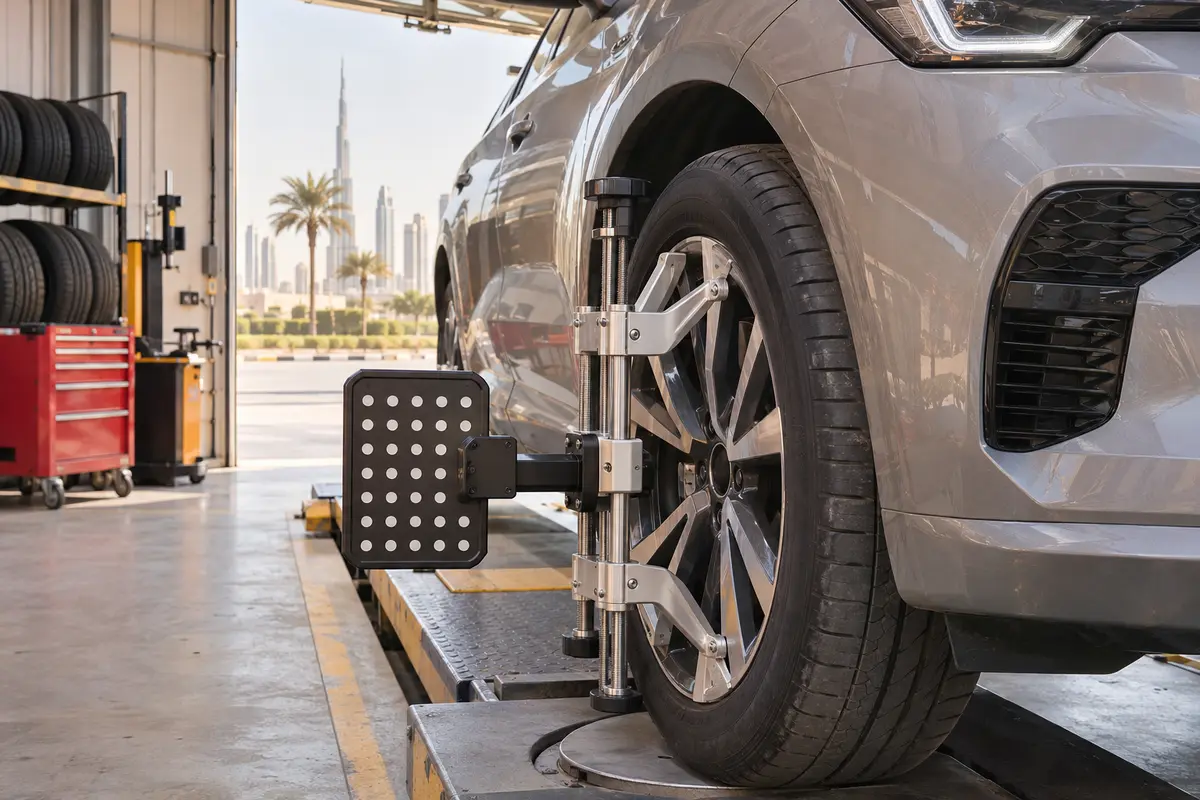
Balancing is different from alignment. Balancing fixes vibration from the wheel itself. Wheel alignment corrects the angles of the wheels so the car drives straight. We explain the difference fully in wheel alignment vs balancing.
What's included
- Removing each wheel and cleaning off old weights and mud
- Dynamic balancing on our van-mounted computer balancer
- Stick-on weights on alloys, clip-on weights on steel rims
- Checking the tyre for bulges or flat spots that cause vibration
- Refitting with correct torque and setting pressures
Signs you need wheel balancing
- The steering wheel shakes at a particular speed band, often 90–120 km/h
- Vibration in the seat or floor at highway speed
- Patchy, cupped wear on the tread
- You recently fitted new tyres or had a puncture repair
- A balance weight has fallen off (look for a clean rectangle on the rim)
- You hit a pothole or kerb hard
How we do it
- Road-test or describe the symptomTell us at what speed it shakes and whether it is the steering (usually front) or seat (usually rear).
- Remove and cleanWheels come off, old weights and stuck-on sand are removed so readings are accurate.
- Spin and measureThe balancer spins the wheel and shows how much weight to add and where, on both inner and outer planes.
- Add weights and re-checkWeights are fitted and the wheel is spun again until it reads zero or within tolerance.
- Refit and confirmWheels are refitted and torqued. If vibration remains we check for a bent rim or tyre fault.
What changes the final price
| Factor | How it affects the price |
|---|---|
| Number of wheels | Price is per wheel. Many people balance only the front pair if the shake is in the steering. |
| Wheel size | Large 20–22-inch SUV wheels are heavier and need more weight and time. |
| Standalone call-out | Balancing on its own needs a call-out. Combined with a tyre change or rotation, it costs less overall. |
| Bent rims | If a rim is bent, balancing alone will not fix it. Rim repair is a separate workshop job. |
Balancing or alignment? Match the symptom
| Symptom | Likely cause | Service |
|---|---|---|
| Steering shake at 100–120 km/h | Front wheel imbalance | Wheel balancing |
| Seat or floor vibration at speed | Rear wheel imbalance | Wheel balancing |
| Car pulls to one side | Alignment angles | Wheel alignment |
| Steering wheel off-centre when driving straight | Alignment | Wheel alignment |
| Inner or outer edge wearing fast | Camber or toe | Wheel alignment |
| Shake that gets worse as you brake | Warped brake discs | Brake service (not tyres) |
If you are not sure, start with balancing. It is cheaper and fixes most speed-related vibration.
Why wheels lose balance in the UAE
- Speed bumps and potholes: residential communities have a lot of them, and hitting one quickly can knock off a weight.
- Sand and mud build-up: after desert trips, packed sand inside the rim barrel adds uneven weight.
- Heat and adhesive: stick-on weights on hot alloys can lose grip, especially cheap ones.
- Tyre wear: as tread wears, the tyre's balance changes slightly.
A lot of the vibration complaints I see in winter are just sand packed inside the rim. A good jet wash of the wheel barrels sometimes fixes it before you even need balancing.
When to balance
Always after fitting a new tyre or repairing a puncture where the tyre was demounted. Otherwise, roughly every 10,000 km or when you rotate your tyres. Unbalanced wheels wear tyres unevenly and stress suspension parts, so ignoring the shake costs more in the end. Our tyre care tips give the full maintenance schedule.
Wheel Balancing near you
We send vans to every area below and many more. Pick yours for local arrival times.