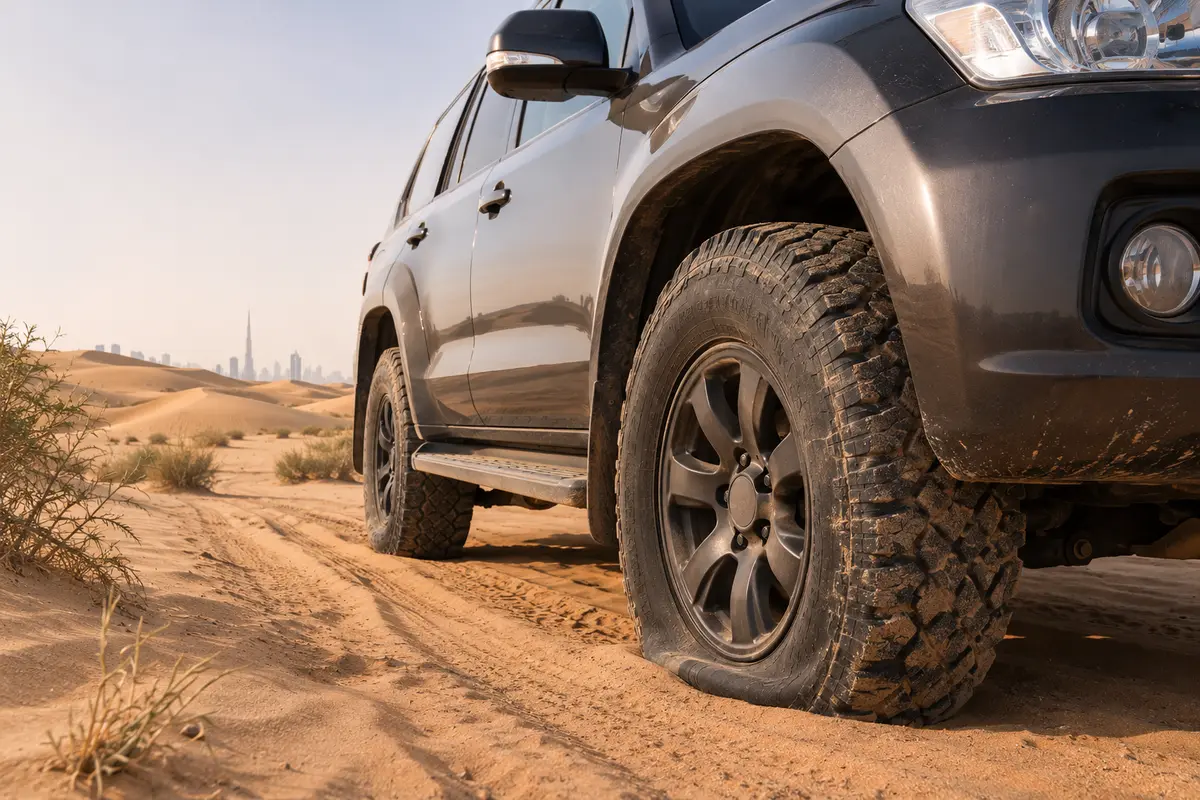
If your weekends involve Al Qudra, Fossil Rock, Big Red or the gravel tracks around Hatta, an AT tyre is usually the right balance. If you never leave the tarmac, a highway-terrain tyre will be quieter and last longer.
How all-terrain tyres are built
An all-terrain tyre has larger, more widely spaced tread blocks than a highway tyre, with interlocking sipes for stability on tarmac. Many are built in LT (light truck) construction with a three-ply sidewall that resists cuts from rocks and the sharp edges you meet in wadis. The shoulder blocks extend onto the upper sidewall to give extra bite when aired down in sand.
Pros
- Strong, cut-resistant sidewalls for gravel and rocky wadis
- Good flotation in sand when aired down correctly
- Long tread life for an off-road capable tyre
- Aggressive look that suits 4x4s and pickups
- Many models carry the snowflake mark, a sign of a well-sorted compound
Cons
- Noisier than highway tyres above 100 km/h
- Heavier, which increases fuel use by a few percent
- Longer braking distance on wet tarmac than a road tyre
- LT sizes need higher pressures and ride firmer
Who should choose all-terrain tyres
Best for
- Weekend dune drives and desert camping
- Gravel and wadi tracks around Hatta and Ras Al Khaimah
- Pickups that carry loads on and off-road
- Owners who want one set of tyres for everything
Not ideal for
- SUVs that never leave the city
- Drivers who prioritise silence on long highway trips
- Serious rock crawling or deep mud
All-Terrain Tyres in UAE conditions
Desert driving in the UAE is mostly soft sand, so the key AT tyre skill is flotation when aired down to around 15 to 18 psi. The danger comes afterwards: driving back onto the E44 or E66 at 120 km/h on soft tyres builds heat very quickly in summer. Reinflate before the tarmac, every time. Our guide to desert tyre pressures covers the numbers.
AT, HT or MT: where all-terrain sits
| Highway-terrain (HT) | All-terrain (AT) | Mud-terrain (MT) | |
|---|---|---|---|
| Tarmac noise | Quiet | Moderate | Loud |
| Soft sand | Fair when aired down | Good | Good, but heavy |
| Rock and gravel | Weak sidewall | Strong | Very strong |
| Tread life | Longest | Long | Short |
| Starting price (17–18 inch) | From AED 380 | From AED 450 | From AED 550 |
For most UAE owners who go into the desert a few times a month, AT is the sweet spot. We explain the trade-off in more detail in all-terrain vs highway tyres for desert driving.
Running AT tyres in the desert
- Air down before the first dune, not after you get stuck. Around 15 to 18 psi is typical for a Land Cruiser or Patrol on AT tyres.
- Keep speeds low and steering smooth while aired down. Sharp turns can roll the bead off the rim.
- Carry a reliable compressor and a gauge you trust.
- Reinflate to road pressure before you rejoin tarmac. Driving at highway speed on 18 psi is one of the most common causes of shoulder damage we see.
Gravel tracks and wadi beds can cut a sidewall without causing an immediate leak. A sidewall cut is not repairable, so inspect each tyre after the trip and book a replacement if you find one.
What I tell customers with a new Patrol is simple: if you go to the desert twice a month, buy AT. If you go twice a year, keep the HT tyres and borrow a friend's car for the dunes.
LT or P-metric all-terrain?
LT (light truck) tyres have stiffer sidewalls and higher load ratings, which suits pickups that carry weight and anyone driving rocky wadis. P-metric or standard-load AT tyres ride softer and are better for family 4x4s that mostly do sand. If you are unsure, our SUV and 4x4 tyres page explains sizes and load ratings.
Popular all-terrain tyres in Dubai
| Brand | Range |
|---|---|
| BFGoodrich | All-Terrain T/A KO2 |
| Toyo Tires | Open Country A/T III |
| Yokohama | Geolandar A/T G015 |
| Falken | Wildpeak A/T3W |
| General Tire | Grabber AT3 |
Typical vehicles: Toyota Land Cruiser, Nissan Patrol, Jeep Wrangler, Toyota Hilux, Ford Ranger, Toyota FJ Cruiser.